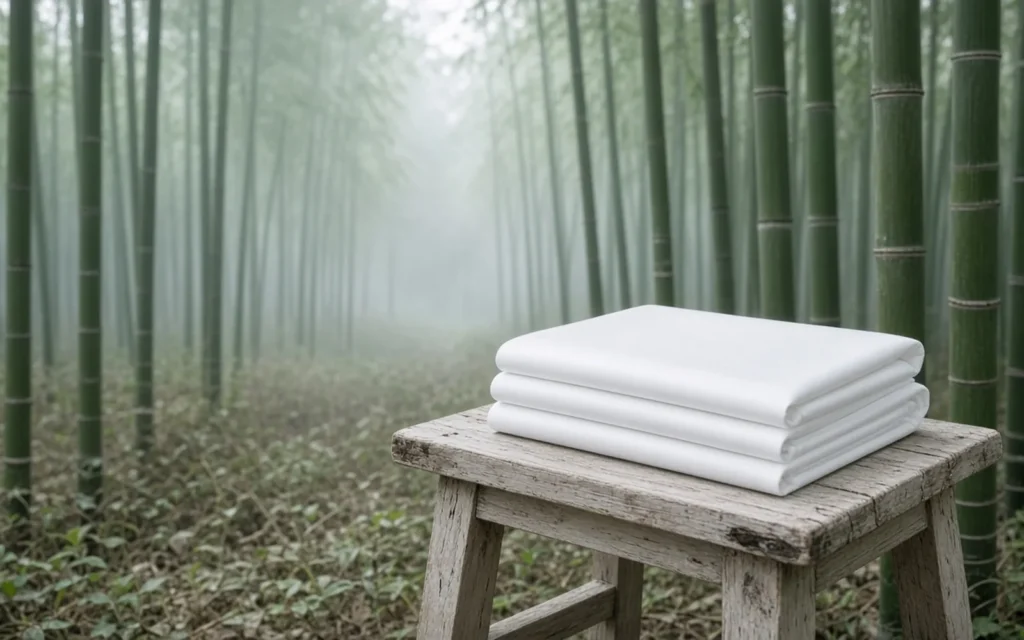
Bamboo has become a symbol of greener living. It grows fast, needs little care and seems almost endlessly renewable. The full story of bamboo bedding is more nuanced. We would rather tell it plainly than lean on a slogan.
What is good about bamboo as a plant
Bamboo is a grass, and one of the fastest-growing plants on earth. Many species regrow from their roots after harvest, so the plant does not need to be replanted. Bamboo is commonly grown with little or no irrigation, relying on rainfall, and it typically needs few pesticides or fertilisers. As a raw material, it has real advantages.
How bamboo becomes a sheet
Bamboo stalks are hard and woody. To turn them into a soft, fine fibre, the plant is broken down into cellulose pulp. That pulp is dissolved with chemicals and regenerated, extruded through tiny openings into long filaments, which are spun into yarn. This is the viscose process.
That is why the accurate name for most bamboo bedding is viscose from bamboo, or bamboo viscose. The fibre began as bamboo, but it has been chemically transformed. It is not “bamboo viscose”, and we do not describe our sheets that way.
The nuance of viscose
Conventional viscose production uses chemicals, including sodium hydroxide and carbon disulphide. Handled responsibly, with chemical recovery and treatment of wastewater, the impact can be reduced. Handled poorly, it can harm workers and nearby waterways. The environmental footprint of bamboo viscose therefore depends heavily on how and where the fibre is produced.
There are also related processes, such as lyocell, which use a different solvent in a closed loop, where most of it is recovered and reused. Fabrics made this way are usually labelled differently, as lyocell rather than viscose. Naturez sheets are bamboo viscose, and we do not describe them as closed-loop or lyocell.
So, is bamboo bedding green?
The honest answer is: it can be part of a more considered choice, but it is not automatically green. A few things to weigh:
- The raw material has a light footprint compared with many crops.
- The processing is where much of the impact lies, and it varies by producer.
- Certification of the finished textile, such as OEKO-TEX® STANDARD 100, tells you the fabric has been tested for harmful substances. It speaks to what is in the product, not to the whole production process.
- How long you keep it may matter most of all.
Beware of easy labels
Words like “eco”, “organic bamboo” or “chemical-free” appear often on bamboo bedding. Some are accurate, many are not. Organic farming, if certified, describes how the plant was grown, not how the fibre was made. And no viscose is made without chemicals. When a claim sounds too simple, it usually is.
The most sustainable sheet is the one you keep
Whatever the fibre, the greatest environmental gain usually comes from buying less and keeping things longer. A set you love, care for gently and use for years is far better than several cheaper sets replaced often.
Some habits help both your sheets and the planet:
- Wash cool, up to 30°C. It is gentler on the fibre and uses less energy.
- Air dry instead of tumble drying, which is easy in the Israeli climate for most of the year.
- Skip fabric softener, one less product in the water and on your sheets.
- Wash full loads, but do not overfill the drum.
- Rotate two sets so each lasts longer.
- Give old sheets a second life as dust covers, cleaning cloths or garden covers.
Questions worth asking any brand
If sustainability matters to you, it is fair to ask:
- What is the fibre, exactly? “Bamboo” or “bamboo viscose”?
- Is the finished textile independently certified, and to which standard?
- What sizes and measurements are offered, so you buy once and correctly?
- What are the care instructions, and are they realistic for daily life?
Clear answers are a good sign.
Fit is sustainability too
A set that does not fit the bed is sent back, repacked and shipped again. That makes careful measuring before you order a small environmental choice as well. One purchase, made correctly, saves shipping, packaging and waste. It is one reason every product page of ours lists every measurement and exactly what the set contains.
Where Naturez stands
We are a family business based in Harish. Our sheets are woven from bamboo viscose in a sateen weave and certified to OEKO-TEX® STANDARD 100, Class II. We describe the fibre accurately, list every measurement so the set fits the first time, and share care guidance that helps it last. We would rather earn your trust with the facts than with a slogan.
